


Architecture student Fariha Yasmin Faruque recounts her experience with fellow students from the University of North South University, Dhaka in the village of Dinajpur, North Bengal.
Bangladesh, in recent years, has had a significant development in the urban areas, particularly in the economy and lifestyle sectors. However this development has only been limited to the major cities, while the rural population, which makes up the majority of the population, still suffers the lack of basic amenities. The main problem in rural areas is the 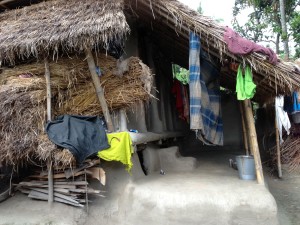 inadequate sanitation, particularly in toilet disposal and hygiene, leading to deadly diseases.
One such small village in Dinajpur in North Bengal has villagers who can’t afford to build toilets for themselves, sharing either their more affluent neighbours’ ones or using the nearby woods for the purpose.
We, the students of the Department of Architecture of North South University, Dhaka, visited this village to volunteer to construct by ourselves, latrines for these people. Supervised by our course teacher, Fawaz Rob, we visited Dinajpur and stayed overnight, studying their lifestyles, politics and structural systems. The villagers themselves had given us their skilful hands during construction. Their gratefulness was visible through their hospitality, especially from Ajit, who’s a member of an NGO through which he got acquainted to our teacher.
Students of the Department of Architecture of North South University, Dhaka including Fariha Yasmin Faruque
The base of each latrine is made of brick where the pan is fitted, while the walls are constructed with bamboo and mats. The toilet disposal is carefully directed to two pits which connect to the agricultural fields so that the organic matter can be used as a fertilizer. As tiring as it might have been in the scorching sun to build the toilets, the ability to provide the cost, labour and most importantly an improved lifestyle to the villagers gave us the joy of helping the deprived.
Below a conceptual design for the toilets that were constructed by the students with the help of the villagers of Dinajpur.
The villagers of Dinajpur are mainly generations of farmers who have used human waste as fertilizers for growing their crops. They have had their mechanisms of treating the waste, taking it directly from the toilet to the fields with buckets. The students design was to provide for the same mechanism they had been practicing for the last few decades, except with a few modifications.
Untreated human waste contains microorganisms that can be fatal to human beings and can also pollute the land. ‘Night soil’ is basically this untreated waste combined with garden soil. In order to avoid using night soil, the villagers
have been asked to create compost piles to decompose the harmful organic matter in human faeces and destroy the chemicals. The waste is first sprinkled with dry straw, crumbled leaves or saw dust and then covered by a compost pile of dried leaves, straw, vegetable peels, garden weeds, stalks etc. The heap is then left in the sun. The two pipes leading to the fields carry the waste materials to the fields where it is treated as a human waste composed pile and then applied as fertilizers.
The compost helps to loosen and aerate the soil and help it retain its moisture.
Great to see students helping deprived villagers of what so many of us take for granted!
Thanks!
Hey isn’t this the trip you made from university just after your thesis? Looks awesome though!
Yup that’s right. Went there from my university thanks to our faculty member, Fawaz Rob. He’s the one who assigned us for this as part of the course.
Bangladesh might have been poor in a lot of sectors but we have excellent resources which, if used correctly could help the country prosper. Unfortunately we need to remove certain problems in order to proceed with to excel with the given resources. Sanitation is noteworthy as a prime issue in the villages and there have been a lot of measures taken by NGOs as well as the government to minimalize the problems of long term effects caused by poor hygienic conditions. These students have done a great job, cudos to their supervisor too. Keep it up!
It was a great pleasure and privilege to have participated in the work…thanks to our teacher Mr. Fawaz Rob for the truly unique experience.
Absolutely! ?
The villgers are mostly generations of farmers who have used human waste as fertilizers for growing their crops. They have had their mechanisms of treating the waste, taking it directly from the toilet to the fields with buckets. Our design was to provide for the same mechanism they had been practicing for the last few decades, except with a few modifications.
Untreated human waste contains microorganisms that can be fatal to human beings and can also pollute the land. ‘Night soil’ is basically this untreated waste combined with garden soil. In order to avoid using night soil, the villagers have been asked to create compost piles to decompose the harmful organic matter in human faeces and destroy the chemicals. The waste is first sprinkled with dry straw, crumbled leaves or saw dust and then covered by a compost pile of dried leaves, straw, vegetable peels, garden weeds, stalks etc. The heap is then left in the sun. The two pipes leading to the fields carry the waste materials to the fields where it is treated as a human waste composed pile and then applied as fertilizers.
The compost helps to loosen and aerate the soil and help it retain its moisture.
Thanks for explaining, I was also looking for this part. Compost pile is useful and effective way of using human stool as fertilizer in the villages. I myself have also volunteered in recycled waste cases in my father’s village (I’m also an architect). The risk lies in the villagers’ capability in handling this effectively, but nonetheless this is a cheap and effective way of treating waste in adequate temperature. You students have done a great job and your mentor’s initiative is praiseworthy.
Interesting work.Bangladesh needs this kind of community services from the youth!
Fariha, Sayed, Sayma. Mehnaz and Oreen many thanks for making time to look at this article and leave comments. We look forward to hearing from you Fariha on how the villagers are getting on with their new facilities and from all of you any future projects you may wish to submit.
Also, they have ruled the market due to their
anatomical constructions of shoes that make the shoes anti-stress with
special shock absorption system. Style- Most of us
looks at the design and style while buying any item.
Toe Size: The right shoe will not only fit well but will also be flexible in the toe
area, with enough space for your feet to relax,
without being pinched in very tight.